France | CNES | ESA | Earth Observation

CNES, France, ESA, and four landmark EO missions

CNES is France's space agency, founded in 1961, and one of the key national pillars behind Europe's launch systems, Earth-observation capability, and climate services. This page focuses on SPOT, Pleiades, SWOT, and VENuS, using real mission imagery and source-backed technical notes.

Founded 19 Dec 1961
Country France
ESA Link France is a founding ESA member
CNES logo

Why CNES matters

CNES is more than a research office. It acts as a programme agency, technical centre, and space operator for the French state. It helps shape national space policy while feeding major European efforts through ESA, the Guiana Space Centre, Ariane launchers, Copernicus, and operational Earth observation.

Main programmes

  • Ariane 6 and independent European access to space
  • Guiana Space Centre as Europe's launch base in French Guiana
  • Copernicus support through optical and altimetry expertise
  • Earth sciences and climate missions for land, ocean, and water monitoring

CNES In Context

France, CNES, and ESA

CNES was created on 19 December 1961 to give France a durable national space capability. That national role still matters: CNES supports French priorities in defense, climate science, agriculture, disaster response, land management, and secure access to satellite data.

At the same time, CNES is deeply interwoven with ESA. France was one of the 10 founding ESA member states in 1975, and CNES remains one of the most influential national agencies inside European programmes. The most visible links are the Guiana Space Centre, which gives ESA member states independent access to space, and Ariane 6, where ESA provides programme oversight and CNES has major responsibility for the ground segment in Kourou.

Interesting factCNES runs across Paris, Toulouse, and Kourou.
Interesting factKourou gives Europe an equatorial launch site on French territory.
Interesting factCNES helped move Europe from SPOT to Pleiades to SWOT.
Four Missions

Flagship EO Satellites

SPOT satellite image of glaciers in the Saint Elias range, often cited from SPOT-5 imagery.

SPOT

Europe's civilian mapping backbone

SPOT, short for Satellites Pour l'Observation de la Terre, was the first dedicated European Earth-observation satellite programme. CNES started the programme in 1977 and launched the first spacecraft on 22 February 1986.

What it observes

Land cover, vegetation, terrain, glaciers, natural disasters, and geographic change.

Open data?

Mixed. SPOT-1 to SPOT-5 archive imagery is accessible through SPOT World Heritage; newer SPOT-6/7 data are commercial via Airbus.

Interesting fact

SPOT's steerable mirrors let it look off-track over a 950 km swath, enabling stereo mapping and more frequent revisits than straight-nadir systems.

Real image example

The image above shows glacier terrain monitored with SPOT data, illustrating why SPOT became so important for large-area cryosphere studies.

Spatial10 m PAN / 20 m MS for SPOT-1 to SPOT-4; 2.5 to 5 m PAN / 10 m MS for SPOT-5
Temporal26-day repeat cycle; 4 to 11 observations per cycle with off-nadir steering
SpectralVisible, near-infrared, and later SWIR bands; SPOT-5 added stronger high-resolution panchromatic capability
RadiometricCurrent Airbus SPOT civil product documentation uses 8-bit pixel coding; legacy generations varied by sensor and product
Pleiades satellite image of the Great Pyramids of Giza in Egypt.

Pleiades

Very-high-resolution, daily tasking optical imagery

Pleiades-1A launched on 17 December 2011 and Pleiades-1B on 2 December 2012. The twin satellites were built to complement SPOT with much finer detail and much higher agility.

What it observes

Very-high-resolution colour imagery for mapping, defense, emergency response, urban analysis, and environmental monitoring.

Open data?

Mixed. Some imagery is free for eligible users through DINAMIS/GEODES, while broader civil distribution remains commercial via Airbus.

Interesting fact

The two satellites can image any point on Earth in under 24 hours and can acquire stereo or tristereo products in a single pass.

Real image example

The image above is a true-colour Pleiades view of the Giza pyramids, a good example of how readable built structures become at sub-metre resolution.

Spatial0.7 m PAN and 2.8 m multispectral at nadir; distributed as 0.5 m and 2 m products
TemporalDaily global revisit with the two-satellite constellation
SpectralBlue 430-550 nm, green 490-610 nm, red 600-720 nm, NIR 750-950 nm, PAN 480-830 nm
RadiometricOfficial Airbus primary bundle products are published with 12-bit pixel coding; display products are commonly 8-bit
SWOT KaRIn first-light visualization over Long Island, New York.

SWOT

Global surface-water and ocean topography

SWOT, the Surface Water and Ocean Topography mission, launched on 16 December 2022. It is a joint CNES-NASA mission with contributions from the Canadian Space Agency and the UK Space Agency.

What it observes

Water-surface height in rivers, lakes, reservoirs, wetlands, coastal waters, and the open ocean.

Open data?

Yes. SWOT products are openly distributed through NASA PO.DAAC, mission portals, and partner services.

Interesting fact

SWOT is the first mission designed to make a global survey of Earth's surface water using wide-swath radar interferometry.

Real image example

The image above is SWOT's official Land First Light, showing Long Island water features measured by the KaRIn instrument on 21 January 2023.

SpatialHeadline CNES figures: 15 km ocean-process scale and mapping of water bodies around 250 x 250 m2; NASA Earthdata also cites about 50 m over land and 1 km over ocean for KaRIn products
Temporal21-day science-orbit cycle
SpectralNot an optical multispectral mission: KaRIn operates at Ka-band, 35.75 GHz, alongside the Poseidon-3C Ku/C-band altimeter
RadiometricNot usually expressed as optical bit depth; the key performance metric is centimetre-scale water-height precision rather than colour intensity coding
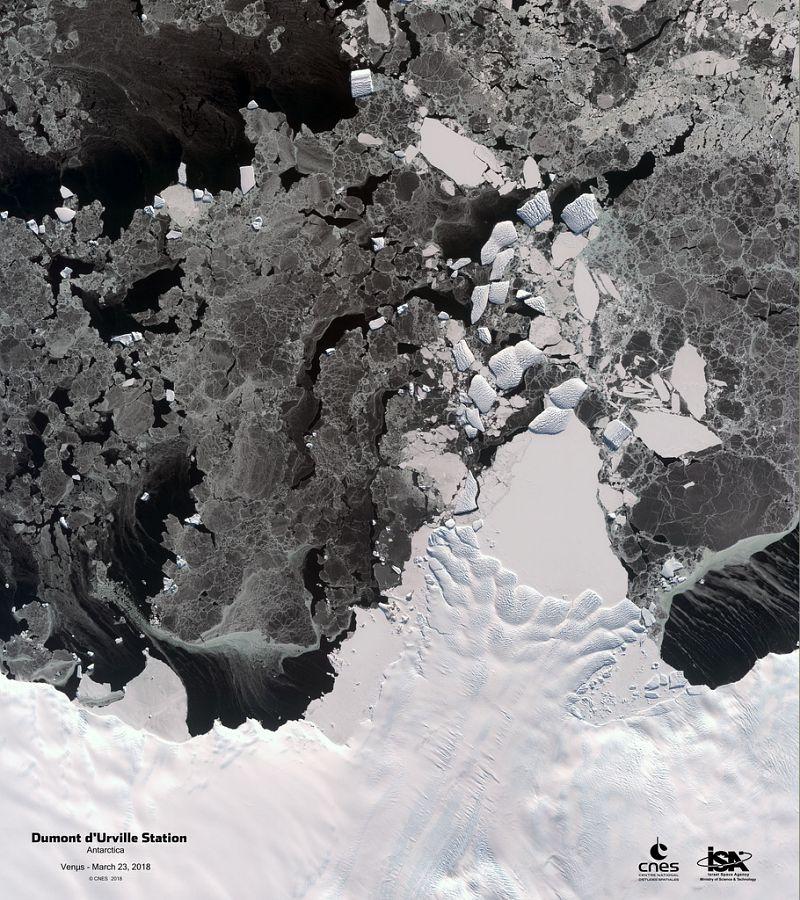
VENuS image of Dumont d'Urville station in Antarctica acquired on 23 March 2018.

VENuS

Dense revisit vegetation monitoring

VENuS, or Vegetation and Environment monitoring on a New MicroSatellite, is a French-Israeli mission launched on 2 August 2017. It was designed to monitor vegetation repeatedly over selected sites with both fine spatial detail and dense temporal sampling.

What it observes

Vegetation health, croplands, ecosystems, coastal and inland-water sites, and red-edge vegetation signals across time series.

Open data?

Mostly yes for science users, through THEIA and GEODES.

Interesting fact

VENuS was the first orbital sensor to combine 12 narrow bands, 5 m-class detail, and a 2-day revisit for vegetation-focused monitoring.

Real image example

The image above shows the French Antarctic base at Dumont d'Urville, acquired by VENuS on 23 March 2018.

SpatialAbout 5.3 m at nadir, commonly summarized by CNES as 5 to 10 m
Temporal2-day revisit at 720 km; later 1-day revisit for selected sites after the orbit change
Spectral12 narrow VNIR bands from about 420 to 910 nm, including several red-edge and water-vapour-sensitive bands
RadiometricCNES emphasizes high radiometric quality and a signal-to-noise ratio around 100 rather than a single headline bit-depth value

Data Access

Open data snapshot

Clearly open

SWOT is the clearest open-data case here, with public distribution through NASA and partner data systems.

Mixed or conditional

SPOT historic archives are partly open, Pleiades is partly eligibility-based or commercial, and VENuS is science-oriented open access.

Sources

Official and scholarly references